Instacart is upgrading its Caper Cart platform with Nvidia’s AI technology, aiming to transform the smart carts into real-time, edge-powered learning systems for physical retail.
The grocery tech company is integrating Nvidia’s Jetson edge AI devices into its carts, enabling on-device processing of data captured from sensors, cameras and scales.
The move is designed to create a continuous in-store intelligence loop, linking shopper behaviour, inventory conditions and merchandising insights.
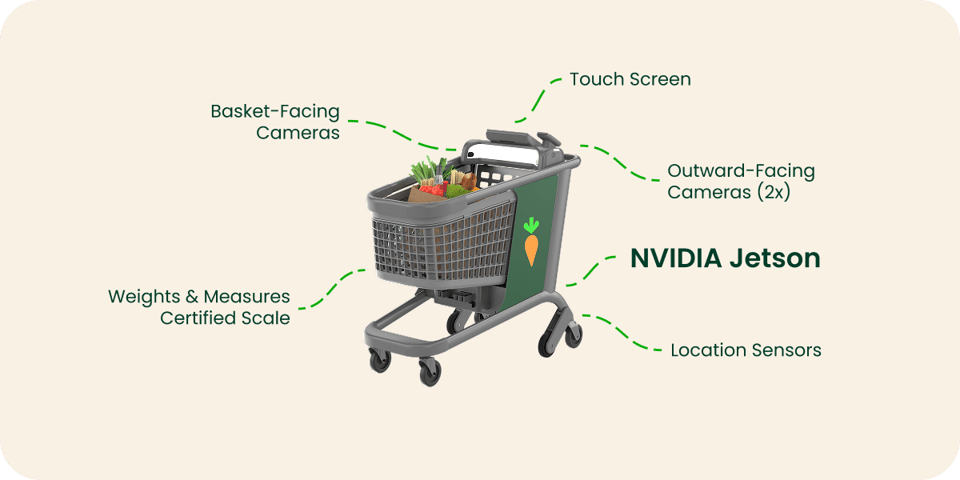
Caper Carts, acquired by Instacart in 2021, are already equipped with computer vision, touchscreens and sensors that automatically identify items as they are placed in the basket.
With the Nvidia integration, each cart processes data locally using a combination of basket-facing and outward-facing cameras, certified weight sensors and location tracking systems, all brought together through sensor fusion powered by Nvidia Jetson.
This allows for real-time item recognition and spatial tracking, even when visual signals are partially obstructed.
The system runs on a dual-layer architecture. Edge processing via Jetson delivers immediate feedback using on-cart sensor data, while cloud-based vision-language models provide deeper contextual reasoning.
These inputs are combined into a unified model that interprets shopper actions, product data, shelf conditions and in-store movement.
Related Story

By fusing weight, visual and positional data, the carts can accurately track multiple items in three-dimensional space within the basket, overcoming limitations such as camera occlusion.
Instacart said thousands of Caper Carts are now deployed across more than 100 cities, with installations tripling year over year.
Collectively, the carts generate millions of daily data points, including what items are added or removed, how shoppers move through aisles, shelf availability and how physical behaviour connects to purchase history.
This enables what Instacart describes as a continuous brick-and-mortar store learning system, offering real-time visibility into both shopper intent and store operations.
The integration positions Caper Carts as more than a checkout tool, effectively turning them into mobile data and recommendation engines.
By synchronising cart-level and shelf-level intelligence, the system can support more precise product recommendations, improved inventory accuracy and better store layout optimisation, reflecting a broader push to embed AI directly into physical retail environments.
Click here to sign up to Retail Gazette‘s free daily email newsletter